
The dMAT syllabus for Indian applicants covers two modules: the Core Module, which is fixed for every candidate worldwide, and the Subject Module, where APS India applicants specifically must sit the General Academic Module. Neither module tests memorized coursework. Both measure how quickly and accurately a candidate can apply reasoning to unfamiliar problems.
That distinction changes how preparation should work. A candidate cannot "revise chapters" for the dMAT the way they would for a university exam, because there is no textbook syllabus behind it.
- Core Module: about one hour and some minutes, split across three fixed subtests that test pattern logic, numeric reasoning, and grid-based problem solving.
- General Academic Module: roughly 90 minutes, testing the application and transfer of subject knowledge rather than recall.
The most reliable starting point is the official preparatory materials published by d-mat.de, paired with timed practice that mirrors the real test's pacing. Everything below breaks that down by module, by task type, and by week.
Key Takeaways
The dMAT syllabus for Indian applicants rests on two fixed pillars: a universal Core Module and, for APS India candidates, the General Academic Module, both scored on applied reasoning rather than memorized content.
| Point | Details |
|---|---|
| Download official materials first | Start with the d-mat.de Core Module and General Academic Module PDFs before any timed practice. |
| Drill all three Core subtests weekly | Rotate Figure Sequences, Mathematical Equations, and Latin Squares every week, not just your strongest one. |
| Schedule full timed mocks | Run at least one complete mock per week in the final month to build real pacing habits. |
| Confirm your APS India classification | Check whether your specific degree title falls under Engineering, Commerce/Finance, or Business/Management. |
| Attempt every question on test day | There is no penalty for wrong answers, so guessing always beats leaving a blank. |
Official materials and registration guidance live at d-mat.de and on the APS India eligibility and format page.
Table of Contents
- dMAT Syllabus Breakdown: The Core Module's Three Fixed Subtests
- Subject Module Syllabus: What the General Academic Module Actually Tests
- APS India Requirement: Who Must Take the General Academic Module
- How to Prepare for dMAT: A Focused Study Plan
- Official Sample Tasks, Worked Solutions, and Test Videos
- Test-Day Format, Rules, and Logistics for India Test-Takers
- Why Format Mastery Beats Syllabus Memorization
- Sources
dMAT Syllabus Breakdown: The Core Module's Three Fixed Subtests
The Core Module is identical for every candidate, regardless of previous degree or destination university, and it consists of exactly three subtests: figure sequences, mathematical equations, and Latin squares.
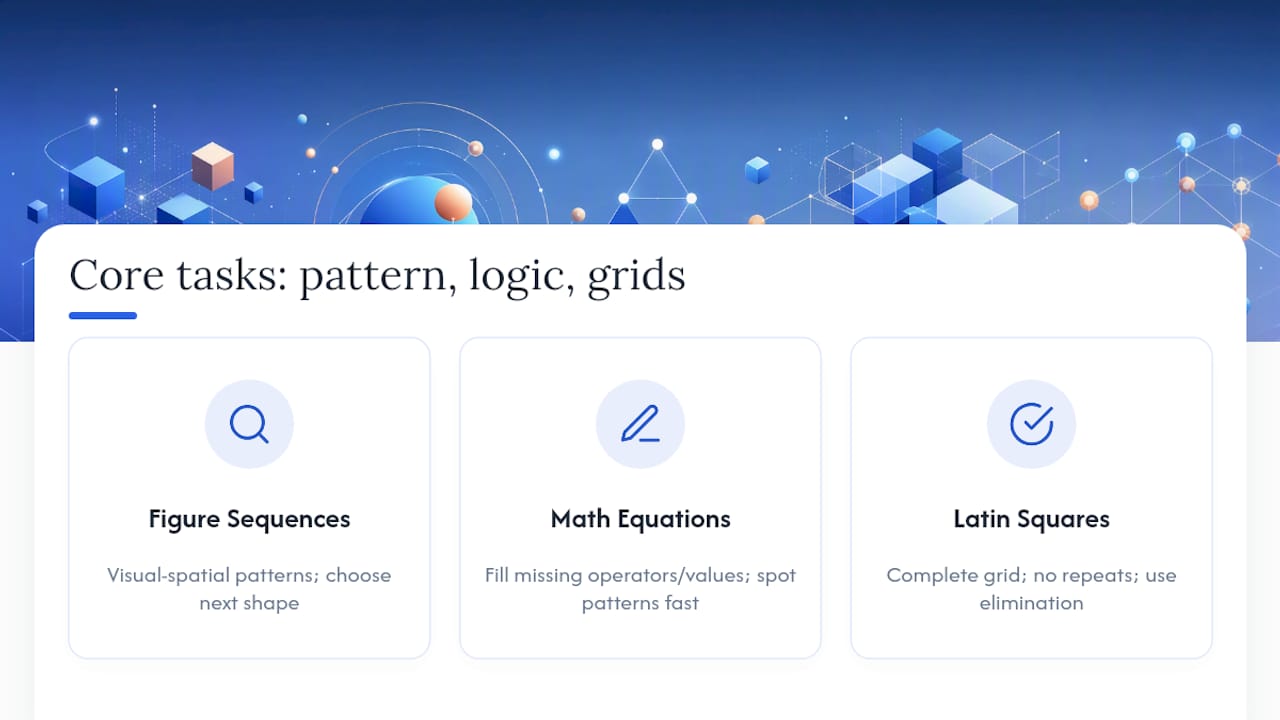
Figure sequences present a string of abstract shapes that follow a hidden rule, and candidates pick which figure continues the pattern. The task tests visual-spatial reasoning under time pressure rather than any subject knowledge, so a strong performance here depends on how many pattern types a candidate has already seen before test day.
Mathematical equations ask candidates to identify missing operators or values that make an equation valid. These are not curriculum-based math problems. They resemble logic puzzles built from arithmetic, and speed comes from recognizing structure quickly rather than doing long calculations.

Latin squares require completing a grid so that no symbol repeats in any row or column, similar in principle to Sudoku but often smaller and denser. This subtest rewards systematic elimination over guesswork.
There is no chapter-style syllabus for any of the three because they aren't academic subjects. According to dMAT prep guides, the fixed task types mean practice should focus on repetition and timing, not content review. The only real "syllabus" is exposure: the more pattern variations, equation styles, and grid sizes a candidate has drilled, the faster they recognize a solution path when the clock is running.
Pro Tip: Triage the Core Module by task familiarity. If a figure sequence or Latin square hasn't resolved within about 70 to 90 seconds, mark your best guess and move on. Guides for Indian applicants suggest pacing around this window per item, and stalling on one hard item routinely costs two easy ones later in the section.
Subject Module Syllabus: What the General Academic Module Actually Tests
APS India applicants take the General Academic Module, and it tests how well a candidate can apply subject knowledge to a short, self-contained problem rather than how much of a degree syllabus they remember.
Each task presents a compact input, a short passage, a data table, a formula, or a diagram, followed by a single-choice question with four answer options. The official preparatory materials show that these inputs are deliberately self-contained: everything needed to answer sits inside the prompt itself, so no outside coursework is required to solve it correctly.
| Subject area | Sample task format |
|---|---|
| Mathematics / computational | Interpreting a formula or numeric model and applying it to a new scenario |
| Natural sciences / engineering | Reading a diagram or process description and predicting an outcome |
| Business / economics | Analyzing a short data table or case snippet to draw a conclusion |
| Social sciences | Applying a stated principle or framework to a brief scenario |
The common thread across every format:
- Short passages paired with a figure, table, or formula, never a standalone essay-length reading.
- Four-option single-choice questions with exactly one correct answer.
- Tasks that combine reading comprehension with applied reasoning, not subject recall.
Difficulty within the General Academic Module varies by item, some tasks stay at a basic comprehension level while others demand a second step of calculation or inference, and the official materials include worked examples at both levels. Candidates preparing through the General Academic Module practice guide will notice the same layered difficulty in structured drills.
APS India Requirement: Who Must Take the General Academic Module
APS India requires the General Academic Module for applicants coming from three main field groups: Engineering; Commerce, Accounting, Finance, or Economics; and Business or Management.
APS classifies degrees using the official degree title, declared major, area of specialization, and academic transcripts, not the applicant's own description of their background. This matters because two students with similar coursework can carry different official degree titles, and APS builds its decision around documentation rather than self-assessment. Interdisciplinary degrees, a Bachelor's blending engineering and design, for instance, or a commerce degree with a heavy computing component, often need individual review rather than a simple match against a list.
The APS India affected-fields list is guidance, not an automatic determination. APS India explicitly states it performs a case-by-case classification for degrees that sit between or across the listed categories.
The requirement applies to applicants targeting Master's programs from the summer semester 2027 intake onward, so students planning an earlier start should confirm their specific timeline directly with APS India rather than assume the rule applies retroactively. Anyone unsure which module their degree triggers should check the APS India eligibility and format page before building a study plan around the wrong module.
How to Prepare for dMAT: A Focused Study Plan
The most effective dMAT preparation guide comes down to one combination: work through the official d-mat.de preparatory materials first, then convert that familiarity into timed practice across all four task categories, figure sequences, mathematical equations, Latin squares, and General Academic Module reasoning.
A compact six-step plan works for most candidates with four to six weeks before test day:
- Read the official PDFs and watch the instructional videos to understand exactly how the on-screen interface presents each task type.
- Drill Figure Sequences in short, timed sets until pattern recognition speeds up.
- Drill Mathematical Equations separately, focusing on operator logic rather than arithmetic complexity.
- Drill Latin Squares with grids of varying sizes to build systematic elimination habits.
- Practice General Academic Module items under timed conditions, treating each passage and question set as a mini comprehension test.
- Run full timed mocks in the final two weeks, then review every miss before the next attempt.
High-impact study activities worth repeating weekly:
- Timed drills capped at realistic per-item pacing, not untimed "study sessions."
- An error log that tracks which subtest or subject area produces the most misses.
- Worked-solution review immediately after each practice set, not days later.
- At least one full mock under real test conditions per week during the final month.
Pro Tip: Use early mock scores to rank your weakest subtest, then weight the next week's practice toward it. There's no negative marking on the dMAT, so leaving a question blank is worse than guessing. Attempt everything, even the items you're unsure of.
For subtest-specific drilling, the Mathematical Equations, Latin Squares, and Figure Sequences practice guides break each task type into progressive difficulty tiers.
Official Sample Tasks, Worked Solutions, and Test Videos
Every serious dMAT preparation guide points to the same starting point: the official d-mat.de preparatory PDFs for the Core Module and the General Academic Module, plus the site's instructional videos explaining how the on-screen test actually runs.
| Resource | What it contains | When to use it |
|---|---|---|
| Core Module preparatory PDF | Worked exercises and sample solutions for figure sequences, equations, and Latin squares | Week 1, before any timed drilling |
| General Academic Module PDF | Sample subject-area inputs paired with 4-option questions and answer explanations | Week 2, once Core pacing feels comfortable |
| Instructional videos | Screen-by-screen walkthroughs of the on-screen test interface | Before the first full mock attempt |
A quick checklist before moving into full-length practice:
- Download both official PDFs and read every worked example, not just the answer keys.
- Complete each sample exercise under a timer, even on the first pass.
- Review sample solutions line by line to understand the reasoning, not just the correct letter.
Test-Day Format, Rules, and Logistics for India Test-Takers
On test day, candidates sit at a computer provided by the test center, meaning no personal laptops, phones, calculators, or reference notes are permitted at any point during the session.
The essential rules to know before walking in:
- Test language is English for the current module versions.
- Every question is single-choice with exactly four answer options.
- No notes, scratch paper, or personal calculators are allowed at the workstation.
- Seating and proctoring follow standard test-center protocols, similar to other computer-based standardized tests.
- Total time on-site, including a scheduled break, runs to roughly 3.5 hours.
Pro Tip: Treat the 30-minute break as an active reset, not idle downtime. Step away from the screen, hydrate, and mentally re-run your pacing plan for the next module rather than replaying items from the one you just finished.
Why Format Mastery Beats Syllabus Memorization
The biggest mistake candidates make with the dMAT is searching for a chapter list that doesn't exist. There's no unit on thermodynamics or macroeconomics to revise, because the test isn't measuring what a candidate memorized in their undergraduate years. It's measuring how fast they can process a new pattern, a new equation structure, or a new subject-area problem under a strict clock.
That reframes what "studying" should even mean here. The candidates who improve fastest aren't the ones rereading old textbooks. They're the ones running timed drills, logging their errors, and tightening their pacing week over week until the format itself stops feeling unfamiliar.
If there's one piece of advice worth acting on in the final four to six weeks before the test, it's this: stop adding new content and start compressing your weak points. Run full timed mocks at least twice a week, review every miss the same day, and drill whichever Core subtest or General Academic subject area keeps costing you time. A simulated environment that mirrors the real interface, timing, and question style, which is exactly what dMAT Practice Lab's mock modules are built to do, closes the gap between "I understand the format" and "I can execute it under pressure."
*— Harmeet
Sources
The most reliable next steps come from three source types: the official d-mat.de preparatory PDFs, the APS India affected-fields guidance, and a small set of curated exam-format guides.
- dMAT for graduate students in India
- dMAT India - List of Affected Previous Degree Fields (APS India)
- Germany APS dMAT Preparation Guide for Indian Students
Third-party chapter lists tend to oversimplify what the dMAT actually tests. The official preparatory PDFs remain the only source that shows real task formats and worked solutions, so treat every other guide, including this one, as a map pointing back to that primary material.