
A personalised study plan sequences your syllabus into time blocks matched to your deadline, your current level, and your weekly hours, then adds review checkpoints so nothing gets forgotten. The single next action: gather five inputs and build a one‑week skeleton today, then refine it as you go.
You need:
- A clear goal (the exam, module, or skill you're targeting)
- Your deadline
- Hours available per week
- An honest read on your current level
- Your best study times (morning, evening, weekends)
Sample one‑day snapshot to copy: Monday — 45 minutes active recall on yesterday's topic, 60 minutes new material, 30 minutes practice questions, 15 minutes flashcard review before bed.
Pro Tip: Write your five inputs on a sticky note before you open any app or template. Tools organise a plan; they don't diagnose your goal or your honesty about where you actually stand.
Key Takeaways
A personalised study plan works because it sequences topics from an honest baseline, time‑blocks them against a real deadline, and uses spaced review to lock in retention.
| Point | Details |
|---|---|
| Start with five inputs | Goal, deadline, weekly hours, baseline level, and preferred study times before building any schedule. |
| Sequence, don't cram | Break the syllabus into 15 to 25 topics and weight effort by difficulty and baseline weakness. |
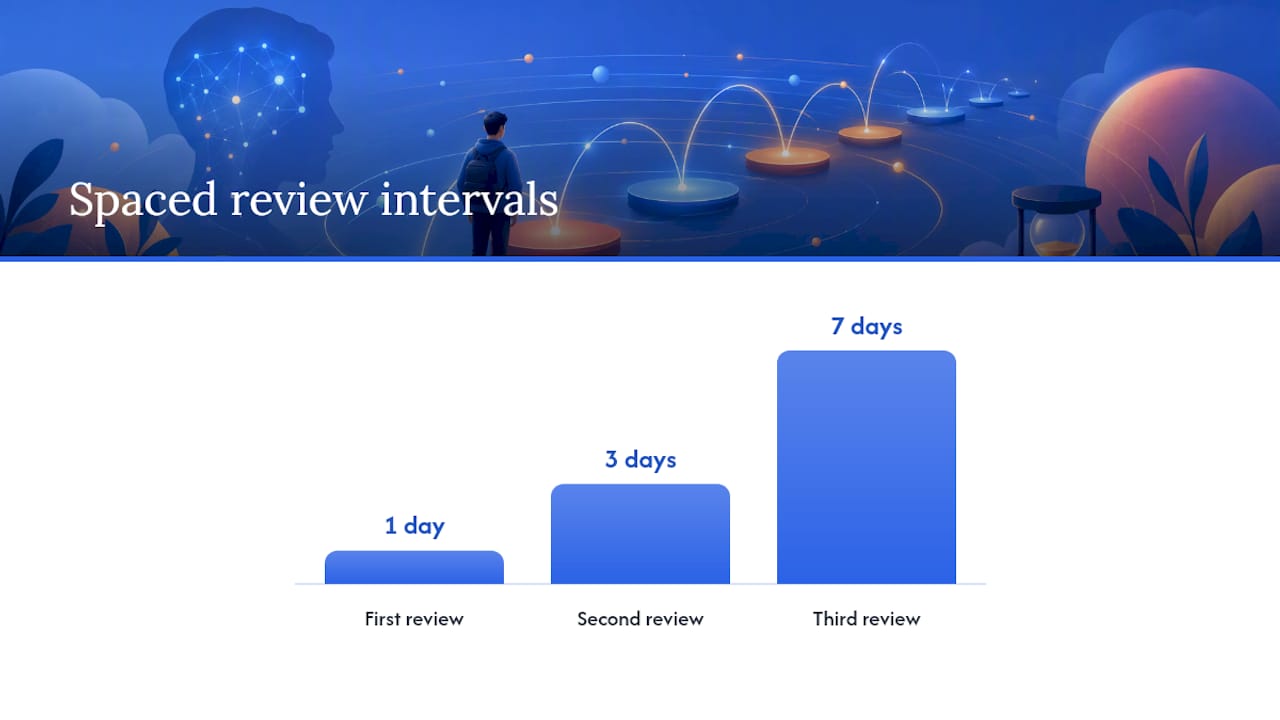
| Space and interleave | Review topics at 1, 3, and 7 day intervals, mixing subjects rather than blocking one at a time. |
| Match hours to horizon | Aim for 3 to 5 hours daily for intensive prep, 1 to 2 hours for steady semester study. |
| Review weekly, adapt fast | Check completion rate and practice scores every week and re‑scope as soon as you fall behind. |
Once your plan and topic list are in place, put your dMAT preparation to the test with timed mock sessions and full practice exams built around the published APS India dMAT format, so your study plan is anchored to genuine practice rather than guesswork.
Table of Contents
- How to build your personalised study plan step by step
- A copy-and-paste four-week study plan template
- Which tools help you build and maintain the plan?
- How do you stick to a study plan when life gets in the way?
- How many hours should you study each day?
- Sources
- FAQ
How to build your personalised study plan step by step
A tailored learning plan works because it starts from an outcome and works backwards, not from a stack of textbooks and a vague sense of dread. Individualised learning pathways that begin with an assessment and get reviewed regularly hold learner engagement far better than a fixed, one‑size‑fits‑all timetable, according to Cedefop's research on tailored learning pathways. Here's the sequence that turns that principle into a working custom study schedule.
-
Define the outcome. Write the exact result you need (pass a module at 70%, sit a specific admissions test, finish a syllabus). Vague goals produce vague plans.
- Name the test or assignment
- Note the minimum acceptable score or grade
- Set the hard deadline
-
Run a baseline assessment. A short diagnostic or honest self‑rating stops you wasting weeks on topics you've already mastered, or skating over ones you haven't. Skills‑assessment research points out that an accurate read of current ability is what keeps a plan calibrated to the right difficulty from day one.
- Attempt one past paper or sample question set cold
- Score yourself topic by topic, not just overall
- Flag anything below 60% as a priority zone
-
List every topic in the syllabus. Break the subject into its component parts rather than treating it as one large block.
- Pull the syllabus or module outline directly from the source
- Split it into 15 to 25 discrete topics
- Mark topics that depend on earlier ones
-
Estimate effort per topic. Not every topic deserves equal time. Weight by both difficulty and how heavily it's tested.
- Rate each topic low, medium, or high effort
- Multiply weak‑baseline topics by 1.5
- Cap any single topic at three sessions before moving on
-
Back‑plan from your deadline. Count backwards from the exam date, leaving the final week for review only, not new material.
- Block out the last 5 to 7 days as revision‑only
- Divide remaining weeks across your topic list
- Build in one buffer week if your timeline allows it
-
Time‑block into a weekly calendar. This is where the plan becomes a schedule you actually follow. Guidance from the Cornell Learning Strategies Centre recommends balancing activity types and building in breaks rather than stacking marathon sessions.
- Assign fixed slots, same time each day where possible
- Mix reading, active recall, and practice problems within each week
- Leave at least one full rest day
-
Add review checkpoints. Schedule short recaps at increasing intervals rather than one final cram. This is spaced repetition and interleaving in practice: review a topic a day after learning it, then three days later, then a week later, mixing topics rather than blocking one subject for hours at a stretch. Both principles are well‑established in cognitive science research on study scheduling, and they work across maths, languages, and reasoning tests alike.
Pro Tip: When choosing session length, shorter and more frequent beats longer and rarer. Four 45‑minute sessions across a week embed material better than one 3‑hour block, because spacing forces your brain to retrieve information rather than just recognise it.
A copy-and-paste four-week study plan template
Here's a four‑week block you can lift straight into a calendar. It assumes 10 to 12 hours a week, split across five to six days.
- Week 1: Foundation. Daily 60 to 90 minute sessions covering new material topic by topic. Friday: light practice set, no new content.
- Week 2: Build. Continue new topics in the morning; add 30 minutes of flashcard review each evening. Saturday: one 90 minute mixed practice test.
- Week 3: Interleave. Stop introducing new material after Wednesday. Mix all covered topics in each session rather than studying one at a time. Sunday: full mock session under timed conditions.
- Week 4: Consolidate. Daily 45 minute review sessions targeting your weakest three topics from mock results. Final two days: light review only, protect sleep.
Scaling rules: for a one‑week sprint, compress weeks 1 to 3 into daily double sessions and keep week 4's structure intact. For a 12‑week plan, repeat the week 1 to 2 pattern for two‑thirds of the timeline, then mirror weeks 3 and 4 exactly as the final fortnight.
Copy this checklist into your planner:
- Topic list with difficulty ratings
- Weekly calendar with fixed blocks
- One mock or practice test per week from week two onward
- Review checkpoints at 1 day, 3 days, 7 days
Which tools help you build and maintain the plan?
The right study plan creator depends on how much structure you want handed to you versus how much you want to build yourself. Three categories cover most needs.
- AI plan generators take your subjects, deadline, and hours, then output a week‑by‑week skeleton with spacing and difficulty curves built in. A sound workflow starts with a concrete outcome and an honest current level before asking the model for a draft, as outlined in Skillscouter's guide to building a learning plan with AI — you still need to verify every resource it suggests.
- Notion suits students who want one workspace holding syllabus, calendar, and progress notes together, with databases you can filter by topic or week. It rewards a bit of setup time but scales well for semester‑long tracking.
- MyMap.ai works well when you want a visual mind‑map style breakdown of a syllabus before you commit it to a calendar, which suits learners who think in structures and branches rather than linear lists.
For quick, low‑stakes plans, a printable template or a service like Canva's study planner gets you scheduling in minutes without an account setup. For mock exam prep specifically, attach a real practice resource to each milestone rather than a generic "revise" block, such as a dedicated practice module for your weakest topic.
Pro Tip: Don't switch tools mid‑cycle. Pick one for the full exam block; hopping between a Notion board and an AI generator halfway through just duplicates your admin without improving your recall.
How do you stick to a study plan when life gets in the way?
A plan only works if you review it. Set a fixed 15 minute slot each week, ideally Sunday evening, to check three things.
- Did you complete at least 80% of scheduled sessions?
- Did your mock or practice scores move since last week?
- Does next week's schedule still fit your actual calendar?
Track time‑on‑task, practice scores, and mock performance as your three core metrics. If practice scores plateau for two consecutive weeks despite completed sessions, that's a signal to change method, not just push harder: swap passive reading for active recall, or add a second mock under timed conditions.
Watch for these red flags:
- Falling behind two or more sessions in a row: re‑scope the remaining weeks rather than trying to cram the backlog in
- Burnout signs (dreading sessions, declining scores despite effort): add a full rest day before adjusting anything else
- Plateau (no score movement for two weeks): change the activity type, not the hours
Pro Tip: Visible progress beats willpower. A simple tick‑box calendar or a topic‑mastery tracker gives you a small win every session, which does more for consistency than any motivational quote ever will.
Wellbeing research on study habits is consistent on this point: plans that flex around a student's actual commitments and energy levels get followed; rigid ones get abandoned by week two.

How many hours should you study each day?
For intensive, short‑horizon exam preparation, a commonly recommended range of focused study hours per day is a commonly recommended range. Steady semester work looks different: roughly roughly one to two hours daily, with spaced review sessions of moderate length rather than long blocks.
The mechanism behind this is straightforward. Spacing forces retrieval rather than recognition, and interleaving mixed topics within a session builds the flexible recall that timed exams actually demand. A baseline assessment at the start tells you which topics need the higher end of that range and which need barely any time at all.
- study sessions of varying lengths from short review blocks to longer coursework and more intensive exam preparation sessions
Sources
- How many hours should you study daily for UPSC? (analyticsIAS)
- Guidelines for creating a study schedule (Cornell Learning Strategies Centre)
- Tailored learning pathways | Cedefop
- How to build a custom learning plan with AI (Skillscouter)
FAQ
What is the 3-2-1 rule for studying?
Definitions vary across sources, but it commonly refers to allocating three review passes, two practice sessions, and one final mock test in the run‑up to an exam, spacing each stage apart rather than clustering them near the deadline.
What does an example study plan look like?
A typical example breaks a four‑week block into foundation, build, interleave, and consolidate phases, with daily sessions of 45 to 90 minutes mixing new material, active recall, and practice questions, plus one timed mock in the final week.
Can AI create a study plan for me?
AI plan generators can build a week‑by‑week schedule from your subjects, deadline, and hours, and can adjust it quickly when your circumstances change, but you still need to verify any suggested resources and anchor milestones to real checks like mock tests.
How do you study 14 hours a day?
Sustained long days sit well outside the researched range of 4 to 6 hours for intensive exam prep, and pushing that hard usually erodes retention through fatigue rather than improving it. A better approach is stacking multiple 3 to 5 hour focused blocks with proper breaks and sleep between them.